


Colombia’s Financial Superintendency has developed the Criteria Panel, a digital platform that centralises and automates risk-based supervision across governance, capital, and liquidity dimensions. Combining Power BI dashboards, NLP, and AI modules, the tool is expected to reduce evaluation times by 60% and set a replicable model for regulators in emerging markets.
Author: Francisco Javier Duque Sandoval, Director, Office of Research, Innovation, and Development, Superintendencia Financiera de Colombia
This article represents the author’s personal perspectives based on research conducted during the Innovation Leaders Residency initiative.
_________________________
How can a supervisory authority modernise its risk assessment approach without losing rigour?
The Financial Superintendency of Colombia (SFC) navigates this question by developing a centralised and intelligent supervisory tool: the Criteria Panel. This platform represents a strategic evolution in the SFC’s risk-based supervision (RBS) implementation, enabling structured, automated, and progressively AI-driven evaluations across key supervisory pillars: risk analysis, business model assessment, and corporate governance.
During the past decade, the SFC staff relied on the Comprehensive Supervision Framework (Marco Integral de Supervisión – MIS) as their principal supervision approach, which was robust, yet it remained strictly manual and fragmented. The 600-page framework of the MIS system-imposed challenges because supervisors needed to do manual criterion extraction and interpretation, which created longer processing times and lowered standardisation. Supervisory assessments took extensive time, while human judgment and errors affected assessments more so when reviewing structured and unstructured data.
To address the limitations of manual supervision under the MIS framework, the SFC developed the Criteria Panel as a core component of its Risk-Based Supervision (RBS) strategy. This digital platform operationalises the RBS approach by centralising the evaluation of the three supervisory pillars and automating the integration of structured data (e.g., financial indicators) and unstructured data (e.g., narrative reports). Through dynamic dashboards, the Criteria Panel enables supervisors to conduct comparative risk analysis, identify trends, and detect early warning signals. The system generates preliminary risk assessments and a Composite Risk Rating (CRR) by applying algorithmic models, which are then validated by expert supervisors. Currently in its second phase of implementation, the platform is being enhanced with Power BI visualisations and AI modules, including Natural Language Processing (NLP), to support more efficient and consistent supervisory evaluations.
What does it mean to bring structure to complexity in supervision?
Supervisors need to establish organisational systems when dealing with complex situations. Power BI serves as the foundation for the Criteria Panel to unite multiple supervisory assessment aspects through a structured electronic platform that improves operational efficiency. The new assessment method enables standardised transparent evaluations through future development opportunities for AI and Natural Language Processing (NLP) to improve document analysis.
How can technology make supervision smarter, not just faster?
The design of the Criteria Panel follows a modular, scalable logic. It integrates structured data, such as financial indicators, with unstructured information extracted from reports, filings, and governance documents. Supervisory teams access this information through dynamic dashboards that facilitate risk comparison, trend analysis, and early identification of vulnerabilities. Preliminary risk ratings are produced algorithmically and subject to expert validation.
Figure 1 illustrates a sample Power BI visualisation from the Criteria Panel, showing how supervisory criteria are organised and assessed across governance, capital, liquidity, and risk dimensions. Preliminary risk ratings are produced algorithmically and subject to expert validation.
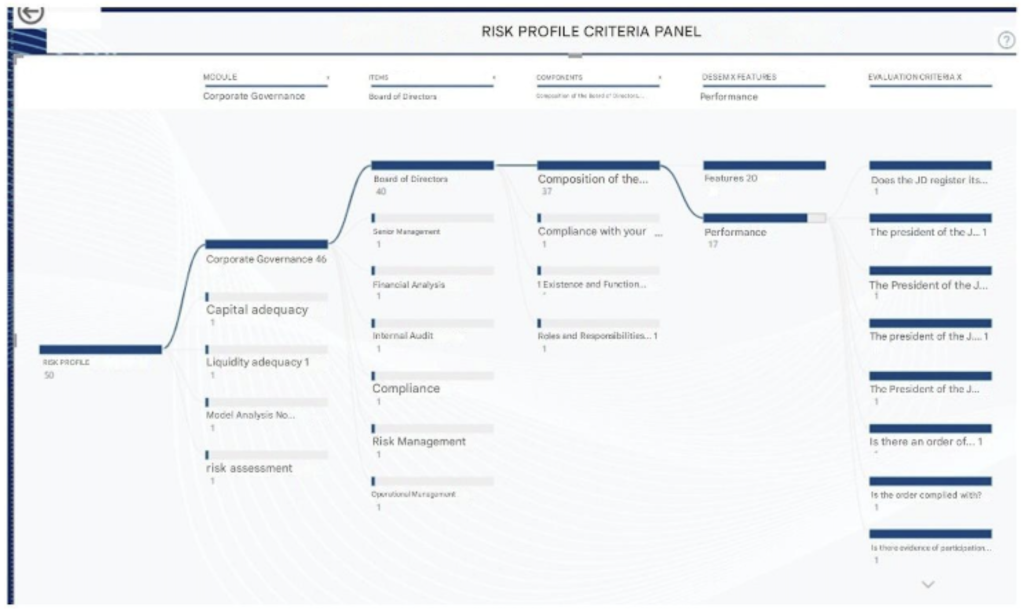
Figure 1: Power BI – Criteria Panel Visualisation
The supervisory transformation follows three implementation stages for its execution. The decision to modernise the supervisory process emerged in early 2024 as part of the SFC’s broader digital transformation strategy, which aimed to enhance efficiency, consistency, and responsiveness in risk-based supervision. This initiative was aligned with institutional goals outlined in the SFC’s Strategic Plan 2023–2026, which emphasised the adoption of suptech tools and data-driven decision-making.
- The first phase (Q4 2024 – Q1 2025) dedicated time to defining project parameters by involving stakeholders while choosing suitable technology systems.
- The platform architecture development and Power BI visualisation integration with AI modules are the main points of focus in Phase 2 (Q2 – Q3 2025).
- Testing and supervisor training will take place during phase 3 as part of the complete distribution (Q4 2025 – Q1 2026).
Figure 2 shows the schematic Diagram of the Envisioned Supervisory Approach, which illustrates how historical and current data will be integrated into the panel and processed to generate visual evaluations and composite risk ratings (CRRs). These automated outputs are expected to increase assessment accuracy while reducing evaluation times by up to 60%.
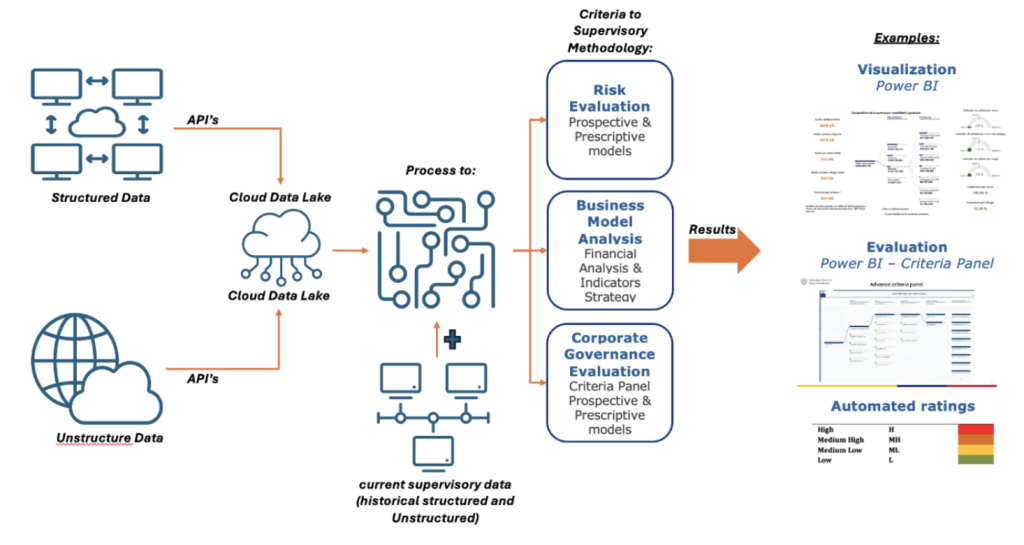
Figure 2: Envisioned Supervisory Approach
How does a local initiative draw on global experience?
The Criteria Panel reflects global supervisory innovation trends, drawing lessons from peer regulators including the Monetary Authority of Singapore (MAS), the Hong Kong Monetary Authority (HKMA), the Bank of England, and the Australian Prudential Regulation Authority (APRA). These agencies have implemented suptech initiatives combining real-time data analysis, interactive dashboards, and AI-driven assessments. For example, MAS’s modular Data Collection Gateway (DCG) and HKMA’s Supervisory Intelligence Platform informed the Criteria Panel’s interoperability features and the integration of NLP into risk review.
The SFC adopted guidance from Financial Stability Board together with IMF and Basel Committee on Banking Supervision to validate that the panel followed international standards. Project Rio (BIS) along with regulatory case studies contributed to developing both suptech architecture and scalability components of the project.
Where does this project stand in the evolution of supervisory technology?
According to the SupTech Generations Framework as described in the State of SupTech Report, the Criteria Panel sits at the intersection between the third and fourth generations of suptech. While its current capabilities include data visualisation, API-based data ingestion, and rule-based automation (2G), it has already advanced toward 3G features such as interactive dashboards, predictive modelling, and Robotic Process Automation (RPA). Moreover, the integration of AI modules for pattern recognition, Natural Language Processing (NLP), and plans for real-time data analytics suggest that the platform is transitioning into 4G territory — characterised by intelligent automation, adaptive learning, and proactive supervisory insights.
Power BI enables dynamic visualisation and filtering, supporting real-time supervisory insights. AI modules, still under refinement, aim to assist with pattern detection and extraction of governance risks from text sources. Over time, the integration of big data processing and more advanced machine learning models is expected to push the panel toward 4G capabilities. While LaTeX is used to generate structured and automated regulatory reports, it is considered a complementary reporting tool rather than a core suptech component.
The RBS approach contextualises the panel, combining business model analysis, risk exposure review, and governance evaluation to produce a unified Composite Risk Rating.
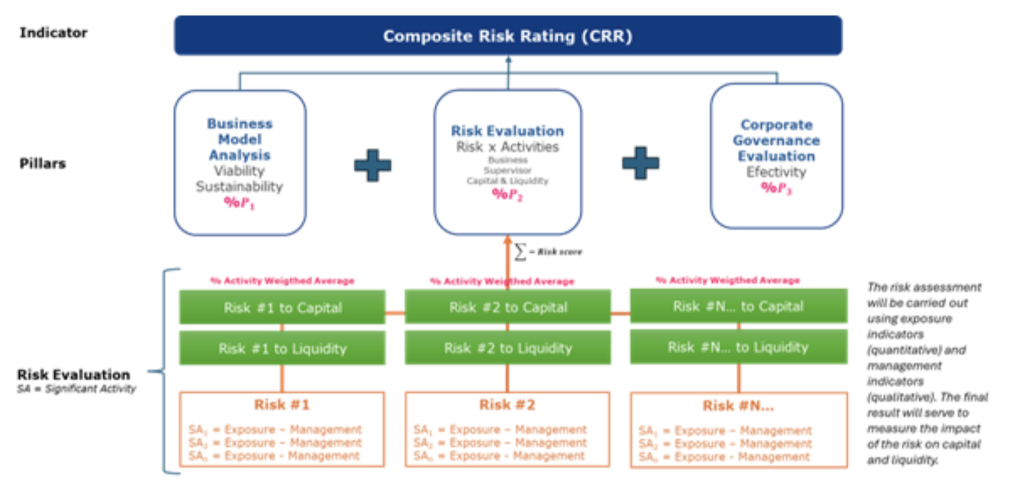
Figure 3: Composite Risk Rating
Who is behind the transformation, and what enables it?
The development of the panel is an internal initiative led by the Supervisory Methodologies and Corporate Governance Unit, in close collaboration with the Technology and Data Analytics Unit, both part of the same Department. Other internal stakeholders include Risk Assessment units and the Regulatory Policy Division. Externally, vendors contribute to Power BI and LaTeX customisation, while international consultants and supervised entities provide feedback on design, functionality, and compliance.
Technologically, the Criteria Panel relies on:
- Power BI for data integration and dashboard development;
- Python and NLP models to process textual reports;
- API connectivity for system interoperability;
- LaTeX to generate final reports under supervisory standards.
This multi-layered infrastructure ensures the platform’s scalability and adaptability to future regulatory changes and data ecosystems. Figure 4 presents a draft structure of the Criteria Panel, illustrating how governance evaluation components — such as board composition, diversity, and operational effectiveness — are assessed through structured criteria and qualitative ratings.
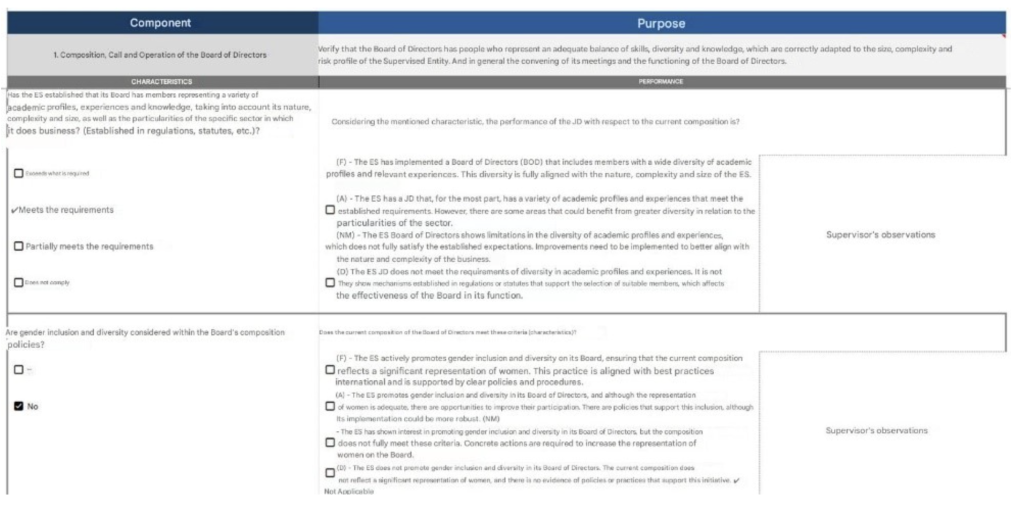
Figure 4: Criteria Panel Draft Structure
What are the early signals of impact?
To monitor progress, the SFC defined Key Performance Indicators (KPIs) focused on efficiency, accuracy, adoption, and usability. Targets include a 60% reduction in evaluation times, 95% consistency in AI-generated outputs, and 85% adoption by relevant supervisory personnel within six months of deployment. The panel is also expected to reduce evaluation errors by at least 10%, particularly those stemming from fragmented data interpretation.
The review process, led by expert supervisors, verifies that AI-generated outputs maintain consistency with institutional evaluation standards. The combination of human and automated assessment provides assurance both for valuable and dependable evaluation results and builds institutional trust in technical oversight methods.
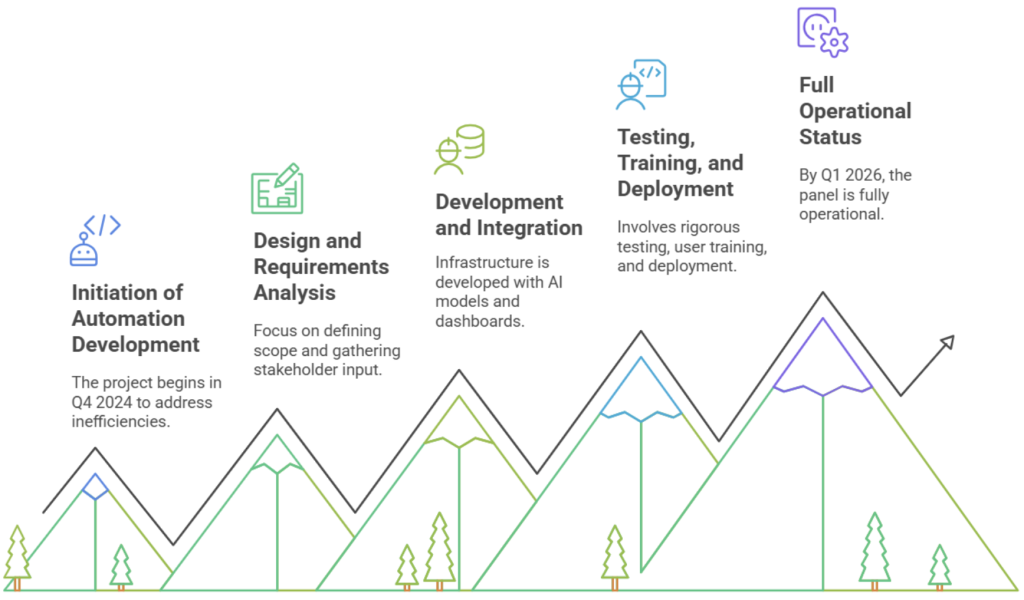
Figure 5: Estimated Project Timeline
What does this mean for supervisors — and ultimately, for consumers?
The panel enhances the quality of supervisory work by freeing analysts from repetitive tasks and enabling focus on strategic risk areas. Automated text analysis reduces manual workload, while visual dashboards support real-time monitoring. For consumers, these improvements translate into a more resilient financial system: better oversight helps mitigate systemic risks, reinforce governance in financial institutions, and ensure equitable regulatory treatment.
What has the SFC learned so far?
The experience underscores the importance of early user involvement, modular system architecture, and a gradual approach to AI adoption. Among the core lessons:
- Do not underestimate the need for training and change management.
- Avoid overloading the first iteration with advanced features.
- Plan for data standardisation and compatibility from the start.
As the panel transitions from PoC to operational tool, the SFC remains committed to expanding its AI capabilities and integrating real-time data analytics. These next steps will reinforce Colombia’s leadership in the adoption of suptech tools and offer a replicable model for regulators across emerging markets.
“Smart Supervision” – an SFC case study
To learn more about suptech efforts at the Superintendencia Financiera de Colombia, access this case study diving into “SmartSupervision” – SFC’s intelligence-led platform for consumer protection and market conduct supervision: https://papers.ssrn.com/sol3/papers.cfm?abstract_id=6298459